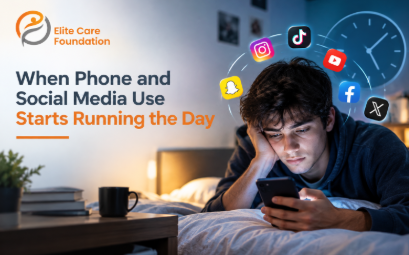
When Phone and Social Media Use Starts Running the Day
A phone can be used for eight hours in a day without all eight hours meaning the same thing.
A business owner may spend hours on calls and messages. A student may watch lectures, use maps, submit assignments and then spend another three hours scrolling short videos. Someone else may check social media every few minutes while trying to study and discover at midnight that almost nothing has been completed.
That is why “screen time” is a useful clue but a poor diagnosis.
There is no standalone WHO diagnosis called mobile phone addiction. What clinicians look for is a pattern of impaired control, harm and functional disruption, while also considering other conditions that may be driving the behaviour.
The most useful question is what the phone interrupts
Sleep is often first.
A person gets into bed at 11 pm and intends to scroll for ten minutes. An hour disappears. Then another. Notifications, messages and short videos make stopping feel strangely difficult because there is always something new after the next swipe.
The next morning begins with the phone before getting out of bed. During work or study, attention breaks repeatedly. Family conversations are interrupted by checking. The person may feel irritated or restless when the device is unavailable, even though they also complain that they are tired of being online.
WHO’s 2022 Health Behaviour in School-aged Children study surveyed almost 280,000 adolescents aged 11, 13 and 15 across 44 countries and regions in Europe, Central Asia and Canada. It found that 11% showed signs of problematic social media behaviour, up from 7% in 2018. Girls reported higher levels than boys, 13% versus 9%. These are regional findings, not Indian prevalence estimates, but they demonstrate why clinicians distinguish ordinary high use from use that is difficult to control and causes consequences.
A Elite Foundation assessment should look beyond the app. Is the person anxious? Lonely? Depressed? Being bullied? Avoiding study because of attention difficulties? Working night shifts? Using the phone to escape family conflict? Different causes need different treatment.
See also: Best Foot Massager in Pakistan for Pain Relief | Highlife
Removing every app may produce a short victory
A parent can delete Instagram. A spouse can demand that the phone remain outside the bedroom. The person can switch to a basic handset for a week.
Sometimes these changes are useful.
But if the underlying pattern is unchanged, the behaviour often moves. Short videos become gaming. Instagram becomes YouTube. One account becomes another. The person may spend less time on one platform but still reach for the phone whenever boredom or discomfort appears.
That is why social media and mobile phone addiction treatment should focus on control and function rather than demonising technology. Phones are part of education, banking, work and family communication. The goal is usually not permanent digital abstinence. It is the ability to use technology without repeatedly losing sleep, concentration, relationships or responsibilities.
A better plan is built around specific situations
“Use your phone less” is too vague.
Useful changes are measurable. No phone during the first 30 minutes after waking. Notifications off during a two-hour study block. Social apps removed from the home screen. The phone charges outside the bedroom. Meals become screen-free. Short-video use is limited to a planned window rather than scattered across the whole day.
These are examples, not universal rules. The plan should match what is actually going wrong.
Therapy may work on urges to check, boredom tolerance, anxiety and the habit of switching attention every few minutes. If low mood or social anxiety is present, simply reducing phone use may leave the person with the same distress and fewer coping tools.
Family involvement can help, but surveillance has limits. Constantly checking another adult’s screen-time report or reading every message can damage trust. For children and teenagers, parents still need appropriate boundaries and safety oversight, but the long-term goal is self-regulation.
High use is not automatically pathological
This safeguard matters, particularly for teenagers.
A socially connected adolescent may spend substantial time messaging friends and still sleep well, attend school, exercise and meet responsibilities. Another may spend fewer total hours online but be unable to stop checking during lessons, lose sleep nightly and become distressed whenever access is restricted.
The second pattern may deserve more attention despite the lower number of hours.
WHO’s data also shows that digital behaviour has positive sides. Online contact can support connection and community. A good treatment approach should preserve useful parts of digital life while reducing the parts that have become compulsive or harmful.
Short-video feeds and endless-scroll designs deserve special attention because there is no natural stopping point. A television programme ends; a feed does not. For somebody already stressed or avoiding difficult work, that design can make repeated checking easy to continue. The solution is still not to diagnose the app. It is to notice whether the person can stop when they intend to and return to the task that matters.
The family does not need to win an argument about whether the phone is “bad”.
It needs to identify the concrete losses: sleep, attention, marks, work, exercise, face-to-face time or emotional stability. Once those are clear, treatment becomes less about the device and more about helping the person get control of the day back.