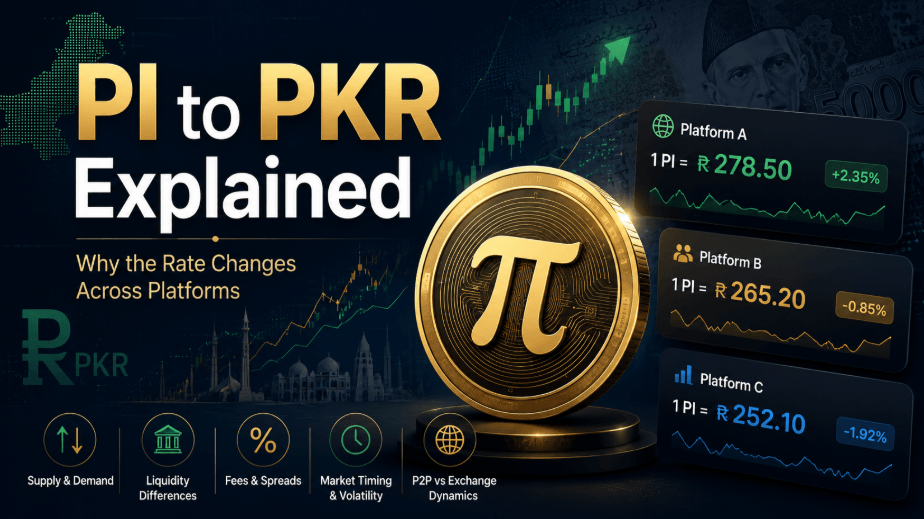
PI to PKR Explained: Why the Rate Changes Across Platforms
Quick answer
The PI to PKR rate differs by platform because most services don’t trade PI directly against Pakistani rupees. They price PI in USD or USDT first, then convert that into PKR, and each platform applies its own liquidity, spread, timing, and fees. The rate that matters is the one you can actually execute, not the highest number on screen.
Key Takeaways
- PI/PKR is almost always a synthetic rate: PI/USD (or PI/USDT) × USD/PKR (or USDT/PKR), not a direct market.
- Exchanges can show different PI prices at the same moment because each runs its own order book.
- Converters like CoinMarketCap show a reference valuation, not a guaranteed sell price.
- The rate you can withdraw as cash is usually lower than a homepage ticker once spreads and fees apply.
- Pakistan’s virtual-asset activity now sits under PVARA, created by the Virtual Assets Act, 2026, confirm a platform’s current status before relying on it.
Market Snapshot: August, 2026
Prices move constantly, so treat this as one dated illustration, not a live rate:
| Source | PI price | Implied PI/PKR* |
| MEXC (PI/USDT) | ≈ $0.08 | ≈ Rs24.70 |
| OKX (PI/USDT) | ≈ $0.08 | ≈ Rs24.59 |
| CoinMarketCap converter | — | ≈ Rs24.58 |
| SBP reference rate | Rs277.6429/USD | — |
*Implied by multiplying the PI price by SBP’s same-day USD/PKR rate, before fees.
Even a 0.5% gap between MEXC and OKX shifted the implied PKR value by more than a rupee, there’s no single “official” PI-to-PKR number.
What Does the PI to PKR Rate Actually Represent?
PI to PKR estimates what one Pi Network token is worth in rupees, so a quote for 1 PI to PKR provides a useful reference point for checking its current value. However, how that figure is calculated, and whether it can actually be executed, depends on the platform.
A direct PI/PKR market needs buyers and sellers trading that exact pair, uncommon today. Most platforms instead calculate a synthetic rate:
PI/PKR ≈ PI/USD × USD/PKR PI/PKR ≈ PI/USDT × USDT/PKR
USD and USDT aren’t interchangeable in every transaction, a bank rate and a P2P USDT rate can diverge. Converters typically show an indicative valuation, not a guaranteed price.
Pi Network’s Open Mainnet has connected to external exchanges since February 20, 2025, so current figures reflect tradable Mainnet PI, not earlier non-transferable balances.
Why Does the PI to PKR Rate Change Across Platforms?
Different PI markets, conversion paths, refresh timing, and fee structures.
- Separate order books. MEXC, OKX, and other exchanges don’t share identical orders, so last-traded prices vary. Thin liquidity widens spreads and increases slippage.
- Different conversion paths. A platform may route PI → USD → PKR, PI → USDT → PKR, or PI → USDT → P2P PKR. A local USDT premium can shift the final figure.
- Different price sources and timing. Tickers may show the last trade, a bid/ask midpoint, an index, an aggregate, or an hourly reference, each lags differently.
- Fees baked in differently. A headline rate rarely equals what lands in your account after trading, network, and withdrawal costs.
Which PI to PKR Rate Should You Use?
| Rate source | Best for | Benefit | Main risk |
| Exchange spot price | Current tradable value | Based on real orders | Spread/slippage; no direct PKR withdrawal |
| Market-data converter | Quick portfolio check | Simple, aggregated | Not necessarily executable |
| P2P/OTC PKR quote | Actual cash-out estimate | Reflects local demand | Counterparty risk, wider spreads |
| Merchant/community rate | One negotiated deal | Supports ecosystem use | May diverge from liquid market value |
Asking “what’s my PI worth?”, use a reputable exchange or aggregator price. Asking “how many rupees will I receive?”, only the executable sell-and-withdraw route answers that.
How to Calculate the Real PKR Value of Your PI
- Find the executable sell price from the order book, not the homepage ticker, for your trade size.
- Identify the conversion route, confirm PI → USDT → PKR rather than assuming a direct PI/PKR market.
- Use an accessible PKR rate. SBP’s Rs277.6429 (Aug 12, 2026) is a benchmark; a P2P or exchange USDT/PKR trade can differ.
- Deduct every cost: Net PKR = PI sold × execution price × PKR conversion rate − trading/conversion/withdrawal costs
Selling 100 PI near MEXC’s snapshot price via USDT/PKR gives a gross value near Rs2,470 before fees; the net figure after costs will be lower. Recalculate with live prices before acting.
Decision Framework: Is the Highest PI to PKR Rate Always Best?
No. Compare the PKR you can actually withdraw, not the biggest advertised number. Weigh:
- Executable bid price, not just the last trade
- Order-book depth at your transaction size
- Whether PI Mainnet deposits/withdrawals currently work on that platform
- Total trading, conversion, withdrawal, and P2P costs
- Fiat settlement options available to you
- Platform, counterparty, and regulatory risk
A higher quote on a thin market can execute worse than a lower quote on a deep one. A P2P buyer may pay a premium but adds payment risk; a large exchange offers clearer execution but custodial risk instead. (MEXC and OKX are cited here only as examples of distinct PI markets, not recommendations.)
How to Spot Misleading or Unsafe PI to PKR Quotes
A quote only matters if you can transfer and sell PI near that value. Watch for:
- An unusually high valuation with no liquid order book behind it
- Screenshots offered instead of a verifiable live price
- Old, non-transferable IOU balances presented as tradable Mainnet PI
- Requests for an upfront “activation” or “unlock” fee
- A displayed price despite deposits/withdrawals being unsupported
- Vague wallet or network destinations
- P2P counterparties asking you to send PI before payment clears
Pi Network has urged caution around businesses claiming Pi-related services and applies its own KYB checks to partners. In Pakistan, virtual-asset activity now sits under PVARA following the Virtual Assets Act, 2026, though rules for individual platforms are still being finalized, verify current status rather than assume coverage.
What Causes the PI to PKR Rate to Rise or Fall Over Time?
Two independent forces move this figure over time:
- PI side: Buying/selling pressure, exchange liquidity, new listings, ecosystem developments, and broader crypto sentiment.
- PKR side: USD/PKR movement, and gaps between official reference rates and accessible crypto/P2P rates.
If PI strengthens while PKR weakens, PI/PKR can rise faster than either move alone suggests; if PI falls while PKR strengthens, the decline compounds. This describes the mechanism, not a forecast.
Conclusion
There’s no single “correct” PI to PKR rate, only the rate you can execute for your situation. Use exchange and aggregator prices to gauge value, but confirm liquidity, fees, and platform status before treating any figure as spendable rupees. When unsure, work backward from the net-PKR formula rather than the headline number.
FAQ
How much is 1 PI in PKR today?
On August 12, 2026, exchange-implied values sat around Rs24.6–24.7 before fees. This changes continuously, check a live exchange or converter for today’s figure.
Why is PI to PKR different on MEXC and CoinMarketCap?
MEXC shows a venue-specific market price from real orders; CoinMarketCap shows a calculated reference rate. Neither automatically equals your cash-out amount.
Is there one official PI to PKR rate?
No. There’s no universal fixed conversion rate, the market source and PKR conversion route both shape the quote.
Should I use USD/PKR or USDT/PKR to calculate PI’s value?
Use whichever matches your actual transaction path. If you’re selling PI for USDT and converting to PKR, USDT/PKR is more relevant than a separate bank USD/PKR reference.